A carefully calibrated message
The controversy began when Andrija Mandic, Speaker of Montenegro’s Parliament and leader of the New Serb Democracy (NSD), announced that he had sent condolences to Ratko Mladic’s son. The message did not openly glorify him or his crimes, yet its political meaning was difficult to miss. The message omitted any reference to the crimes he was found guilty of and referred to him as a general. Instead of sending a purely private family gesture, Mandic chose to give it greater weight to send the message in the name of his party.
Mandic’s language was markedly more restrained than that of fellow Montenegrin Serb politician Milan Knezevic, leader of the Democratic People’s Party (DNP). Presenting Mladic as a collective Serb hero, Knezevic posted a photograph of Mladic with the message: “Glory is eternal, and suffering is brief. Every Serbian home has a Ratko.” In a significantly lower tone, Mandic framed his message as condolences to the family alone, saying it was sent in accordance with Serbian customs. He stressed that as a Serb, he would not retreat “a single millimetre” in the face of criticism from the Democratic Party of Socialists (DPS), accusing former president Milo Djukanovic of having supported Republika Srpska during the 1990s.
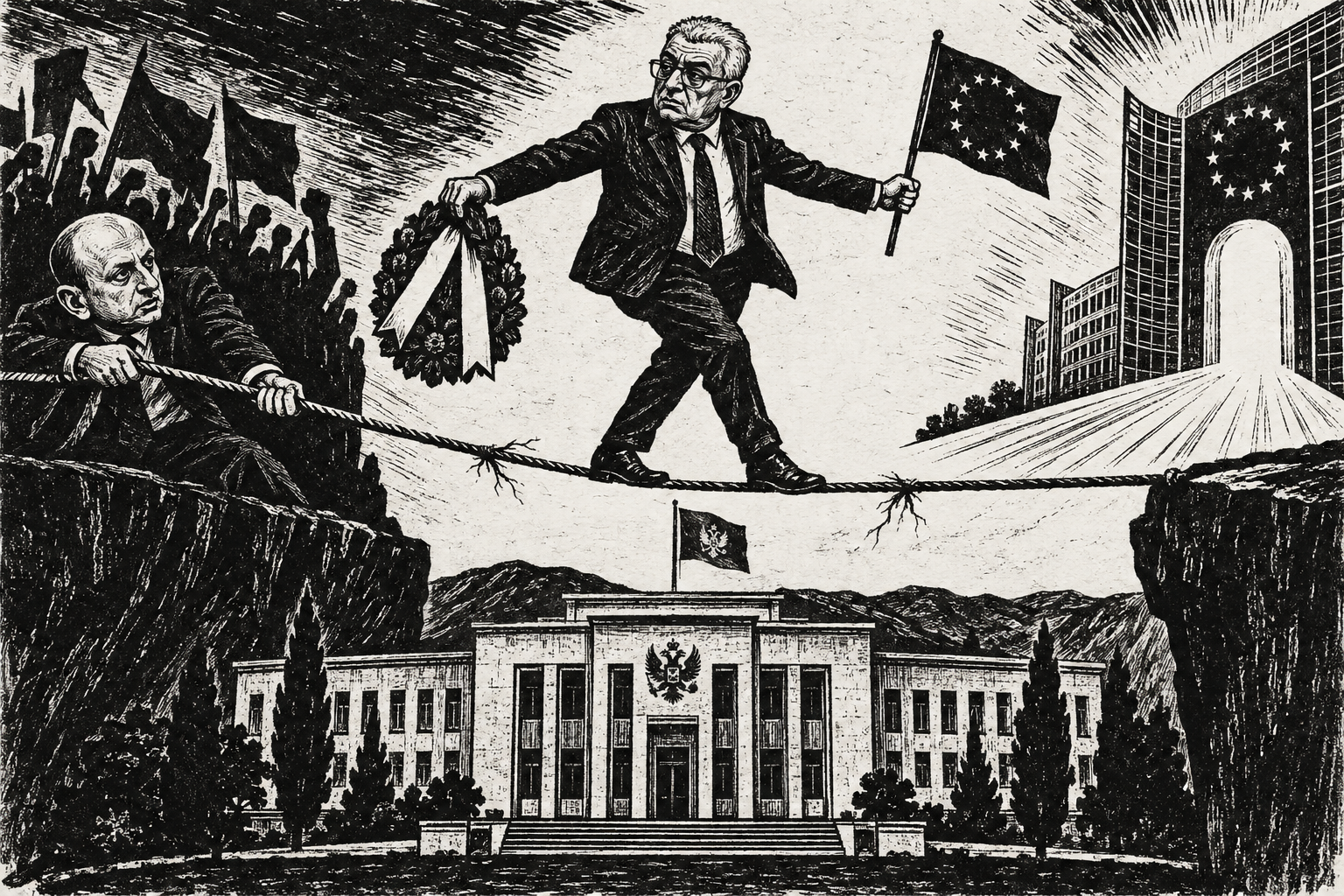
Editorial illustration accompanying the article: nationalist loyalties and Montenegro’s European ambitions pull in opposing directions.
Seeking to assure the public that he remained committed to Montenegro’s European agenda, Mandic said that he plans to be in Brussels to raise the Montenegrin flag when the country joins the European Union. Andrija Nikolic, head of the DPS parliamentary group, responded that before that moment Mandic would first have to apologise to Srebrenica.
Political reactions
Independent and pro-European media treated the condolence as a deliberate political signal, arguing that Mandic’s party role cannot be cleanly separated from his state office as parliamentary speaker. The DPS launched an initiative to discharge him, supported by several parties, including one which is part of the governing coalition.
The motion nevertheless appears unlikely to succeed because Prime Minister Milojko Spajic’s Europe Now Movement (PES) said it will not vote his dismissal. The broader argument espoused by PES that it did not want “an ugly past to destroy a bright future” captures the governing coalition’s dilemma: disapproval of Mandic’s symbolism without a willingness to impose a political cost that could destabilise the coalition.
Tonino Picula, the European Parliament’s rapporteur for Serbia criticised Mandic’s move arguing that he consciously sought to underline his role as a leading custodian of Greater Serbian politics in Montenegro, calculating that the gesture would carry no serious consequences either for him personally or for Montenegro’s EU negotiations. In an interview with Pobjeda, Picula cautioned against treating the episode as an isolated incident and called on pro-European politicians to distance themselves from Mandic’s irresponsible orientation.
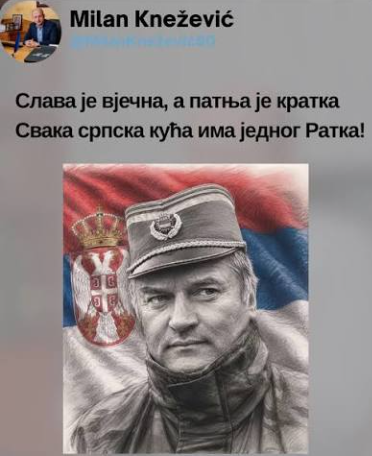
Screenshot reproduced in the source article of Milan Knezevic’s post featuring Ratko Mladic. The accompanying text is discussed in the article.
The contest for the Serb nationalist electorate
The episode should also be read through the increasingly visible rivalry between Mandic and Knezevic for leadership of Montenegro’s Serb nationalist electorate. As Knezevic has sought to expand his support through more radical rhetoric, Mandic has faced growing pressure to reassert his own nationalist credentials and prevent his former ally from claiming an exclusive right to speak for the most hard-line Serb voters.
Shortly before Mladic’s death, Knezevic publicly described the strategic difference between himself and Mandic. The two do not disagree over the goal of Serbian interests, but over how to pursue them: through participation in government, as Mandic prefers, or by depriving what Knezevic regards as an anti-Serbian government of political legitimacy.
With elections looming soon, many find alarming that Knezevic’s support has continued to grow. A survey found that five-times more respondents identified Knezevic as the leader of Montenegro’s Serbs compared to Mandic. NSD still retains an electoral advantage in some polls, but Knezevic’s personal popularity is higher, a pattern also visible in Spectrum Analitika polling.
Mandic’s middle formula
Mladic’s death created a politically difficult test of nationalist credentials. Silence would have given Knezevic an open field to present himself as the only authentic leader of Montenegro’s Serbs. Open glorification, however, would have threatened Mandic’s institutional position, Montenegro’s EU accession process, and relations with Croatia and Bosniak political actors.
Mandic chose the middle-ground partial recognition of Mladic in a seemly private expression of condolence, pursuing four incongruent objectives: (a) preserve his nationalist credentials in the face of Knezevic’s rise, (b) signal solidarity with the wider political space of the Serbian World, (c) avoid an open rupture with the governing coalition, and (d) test whether his coalition partners and the European Union are actually prepared to impose a tangible political cost.
The domestic part of that test has partially worked already. Mandic’s partners have distanced themselves verbally but are not prepared to remove him. This dynamic leaves him structurally vulnerable to Knezevic, who can always move further to the right than Mandic. The strategy nevertheless exposes an underlying weakness as his pro-EU positioning increasingly looks tactical.
Back to Regional Stability Watch