One day before Montenegro's Independence Day on 21 May, two television stations close to Serbia’s governing establishment broadcast a film questioning the legitimacy of the Montenegrin state. Twenty years earlier, on the same date, 55.5% of participating voters chose to leave the State Union of Serbia and Montenegro and establish an independent state.
On this major anniversary, pro-Serb outlets broadcast a documentary titled Referendum: A Story of an Imagined Freedom, depicting the 2006 referendum as an internationally assisted project built on elite interests and identity manipulation. In line with Serbia’s narrative, the story claims that the very purpose of independence was to manufacture Montenegrin identity as a political, cultural and symbolic battle against the Serb state.
The most inflammatory passage concerns the film's treatment of Cetinje, Montenegro's historic royal capital and a central symbol of its statehood and anti-fascist tradition. Insinuations about the women of Cetinje under Italian occupation during World War II are misogynistic, historically false and collectively degrading. The documentary’s broader thrust, however, goes further: it seeks to delegitimise Montenegro’s statehood.
The documentary was produced within a media-political milieu close to Serbia’s governing establishment, promoted by sympathetic outlets in Serbia and then shown through locally incorporated channels in Montenegro. Senior Serbian and Serb Montenegrin figures appear in the film, which Serbian President Aleksandar Vucic defended after the backlash.
A referendum recast as manipulation and betrayal
The film’s central aim is to portray the 2006 referendum as manipulated, thereby calling the legitimacy of the state into question. Montenegro’s independence is depicted as an elite-engineered betrayal, and its identity as an artificial construction and its orientation as evidence of Western capture. Built on these premises, each subsequent decision can be folded into a conspiracy narrative about Montenegro’s departure from Serbia’s political and cultural space: recognition of Kosovo in 2008, accession to NATO in 2017 and pursuit of European Union membership.
Montenegro’s unresolved geopolitical divide
Since 2006, and especially since NATO accession, parts of Serbia’s political, media and cultural establishment have treated Montenegrin statehood with strategic ambiguity. Just short of formally challenging its independence, they describe Montenegrin identity as artificial, generalise allegations of anti-Serb discrimination, use the Serbian Orthodox Church as a vehicle for political mobilisation and portray Euro-Atlantic alignment as Western coercion. The film now extends this narrative to challenge the very foundations of the state’s independence.
How the narrative exploits Montenegro’s identity divide
The documentary targets a society marked by overlapping identities and deep divisions over religion, nation and state. Montenegro has a substantial population identifying as Serb, while parties appealing primarily to Serb voters have gained considerable political influence over the years. Rather than acknowledging political and identity differences as legitimate, the discourse promoted from Serbia treats Montenegrin identity as a fraudulent rupture from a supposedly unified Serb identity. It turns genuine debates about history and identity into a political instrument for keeping the country’s sovereignty permanently open to dispute.
Attack on Montenegro’s traditional political repository
Cetinje holds singular importance for Montenegro as its historic royal capital and an enduring national, political and cultural memory. The attack on Cetinje is therefore not incidental for it attacks the strongest repository of a distinct Montenegrin political tradition. By escalating political disagreement into collective humiliation, the documentary performs a classic function of nationalist propaganda where history is used as a test of blind loyalty, where the correct answer marks coexistence as dishonest.
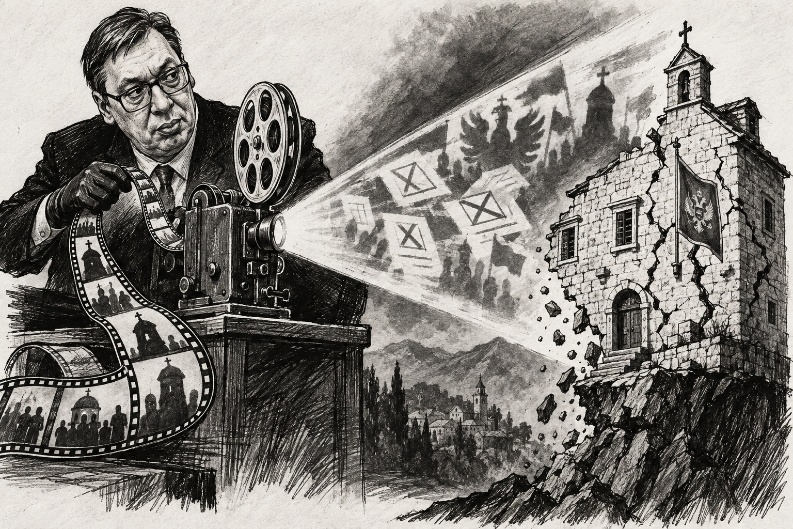
Editorial illustration accompanying the article: a film projector turns symbols of history and identity into pressure on Montenegro’s statehood.
Produced by the Serbian World ecosystem
Promoted as the biggest think-tank in Serbia, the Center for Social Stability, which produced the film, sits within an ecosystem aligned with Serbia’s leadership and its Serbian World nationalist project. Modern influence operates through an aligned market of incentives involving public grants, municipal contracts, advertising by state-owned companies, broadcaster co-financing and support for politically sympathetic nongovernmental organisations. The documentary was promoted through Prva TV and Adria TV in Serbia, and broadcast in Montenegro by their local offshoots. Serbia’s culture minister, Nikola Selakovic, appeared alongside nationalist historian Aleksandar Rakovic and politicians including Milan Knezevic, Predrag Bulatovic and Nebojsa Medojevic.
Vucic defends the film and accuses Montenegro of censorship
In Montenegro, the Democratic Party of Socialists, representatives of URA, public figures from Cetinje and media groups denounced the production. The Media Self-Regulation Council described it as political propaganda and urged scrutiny of possible breaches of professional standards. Some politicians demanded broadcaster suspensions while others proposed to declare Vucic persona non grata. Vucic said that he had watched part of the film, found nothing insulting and portrayed calls to restrict its broadcast as intolerance of alternative views.
Laying the ground for harder forms of pressure
A provocative documentary is not proof of an imminent security threat, but it prepares the social terrain on which harder forms of pressure become easier. Hybrid influence gains impact when it ceases to appear foreign and its themes filter into mainstream domestic discourse, deepening mistrust in institutions, casting political opponents as traitors and encouraging the belief that sovereignty is merely a temporary elite fiction.
Belgrade’s claimed duty to correct its neighbours
A recurring strand of Serbian nationalist discourse applies a similar template across the region. In Kosovo and Bosnia and Herzegovina, statehood is portrayed as externally imposed and their identities as inferior. In Montenegro, national identity is framed as artificial and in North Macedonia, the independence of the national church is questioned. Under this logic, any neighbour that moves away from Belgrade’s orbit embodies a historical injustice that Serbia claims a duty to correct and to come to the defence of local Serb communities.
A regional security signal
Beyond its bilateral character, the dispute tests whether the post-Yugoslav order can resist organised manipulation without suppressing pluralism. Western capitals often wait until narratives become crises before reacting, but regional governments should recognise the destabilising potential and treat this episode as a warning. The challenge is whether democratic institutions, independent media and Western partners can expose the networks, financing and political purpose behind organised manipulation before narratives harden into crises and how leaders who stand behind such messages are treated by Brussels.
Back to Regional Stability Watch